How Long Is 50 Feet? A Comprehensive Guide With Things That Are 50 Feet
50 feet is a significant distance that remains easily visualized in everyday contexts. This length is roughly equivalent to five cars parked bumper to bumper or the length of a regulation swimming pool.
Whether you are designing outdoor spaces or assessing safety distances, understanding common 50 foot landmarks provides an immediate and practical point of reference. Let us explore the vehicles, structures, and objects that perfectly illustrate this impressive measurement.
How Long Is 50 Feet?
| Unit | Measurement |
| 50 feet in inches | 600 inches |
| 50 feet in cm | 1524 cm |
| 50 feet in mm | 15,240 mm |
| 50 feet in m | 15.24 m |
10 Most Common Things That Are 50 Feet Long

Olympic Swimming Pool (Half Length)
An Olympic swimming pool is 50 meters long, or almost 164 feet. While competitive athletes require these full scale facilities, many sporting lap pools are designed at a more modest 50 foot length, which remains enough for effective training in residential and gym settings.
Semi Truck (Without Trailer)
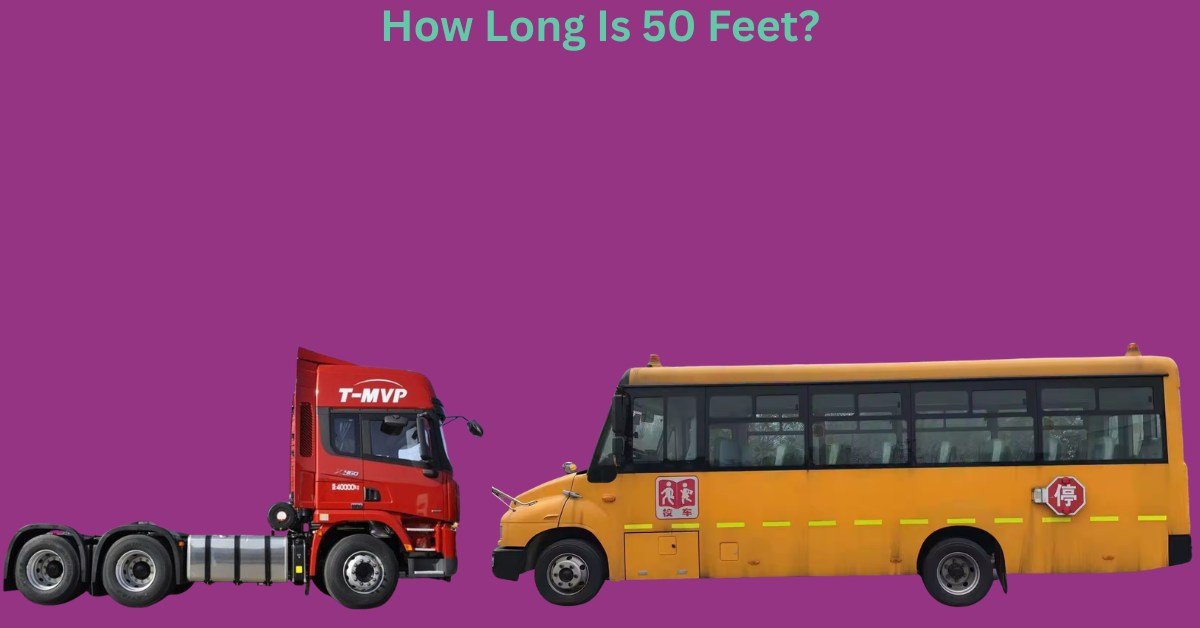
A semi truck tractor unit, without its trailer, typically measures between 45 and 50 feet. Once a full trailer is attached, the total length of the vehicle exceeds 70 feet. For those in the logistics industry, this familiar tractor unit provides a clear, real world reference for how far is 50 feet.
School Bus ( Slightly Longer)
A standard full size school bus measures roughly 35 to 40 feet in length. A 50 foot span is about 25 percent longer than the iconic yellow bus. When accounting for front bumpers and rear overhangs on larger models, these vehicles serve as excellent mental markers for visualizing this specific length.
Five Average Cars ( End-to-End)
The average sedan is almost 14 to 16 feet long, meaning five standard cars parked bumper to bumper would stretch between 70 and 80 feet. If you use smaller compact cars measuring 10 feet each, a row of five vehicles perfectly demonstrate a 50 foot distance. This method is frequently used by parking lot designers for space planning.
Garden Hose
Garden hoses are commonly sold in 25, 50, 75, and 100 foot lengths, with the 50 foot variety being a staple for residential lawn care. Because this length is designed to reach most corners of a typical yard, it serves as a highly relatable and flexible reference for how long is 50 feet visually.
Four Story Building
Commercial buildings typically average 12 feet per story, resulting in a total height of 48 to 50 feet when accounting for the roof and foundation. Residential structures with 10 foot ceilings generally reach 40 to 45 feet across four floors. For urban residents, a four story building serves as a practical architectural reference point for a 50 foot vertical span.
Bowling Lane
In the context of athletics, a regulation bowling lane measures 60 feet from the foul line to the headpin, meaning 50 feet represents almost 83 percent of the lane’s total length. This familiar distance is a useful visual aid for bowlers and sporting players alike, as these standard dimensions are maintained regularly in alleys worldwide.
Fire Truck Ladder (Extended Partially)
Emergency services also rely on 50 foot measurements during operations. While fire truck aerial ladders typically extend between 75 and 100 feet, 50 feet marks a common, partially extended position frequently used to reach the third and fourth floors of residential structures during fire response training and active incidents.
Yacht or Sailboat (Mid Size)
In the marine world, 50 feet is a popular size class for serious cruising yachts. Vessels in the 45 to 55 foot range offer a balance of comfortable living space and ocean crossing capabilities. Consequently, marinas often designate premium slips specifically to accommodate these vessels, which represent a significant investment in long distance voyaging.
Small Footbridge
50 foot spans are common in landscape architecture, particularly for pedestrian bridges crossing small creeks or ravines. These structures, which typically range from 40 to 60 feet in length, provide an elegant connection for trails and private estates, perfectly suiting most small scale crossing requirements.
Conclusion
Fifty feet is a common measurement encountered in diverse settings, from the length of semi-trucks and garden hoses to the dimensions of swimming pools, boats, and four-story buildings. To visualize this distance, imagine a line of five compact cars parked bumper-to-bumper.
By keeping these familiar examples in mind, you can more easily estimate distances for property planning, landscaping, safety assessments, and vehicle evaluations. Utilizing these standard reference points will help you gauge spaces and dimensions with greater confidence and accuracy.
FAQs
How Big Is 50 Feet?
50 feet is 600 inches big.